Royal Valley Casino Account, Registration and Player Controls
 Available in GB
A Royal Valley account is more than a sign-up form. For a UK player, the useful way to understand the account lifecycle is to separate account creation from the checks and controls that can operate after registration. Royal Valley publishes daily, weekly and monthly deposit limits, with increases taking 24 hours to become active and decreases applying immediately. It also provides self-exclusion for periods from six months to five years and reality-check reminders at intervals from five minutes to one hour.
Verification can also become part of the account experience. Royal Valley may request identity, address, payment-method and source-of-funds evidence, while UK Gambling Commission rules require licensed remote operators to maintain self-exclusion procedures, participate in the national multi-operator self-exclusion scheme and carry out financial vulnerability checks when the relevant regulatory conditions are met. Exact document categories and approval timing are covered in the dedicated Royal Valley verification.
Table of Contents
- Account controls at a glance
- Registration is the beginning, not the whole account journey
- Deposit limits: the timing rule is the important detail
- Self-exclusion at Royal Valley and the role of GAMSTOP
- Reality checks are time reminders, not spending limits
- Verification and source-of-funds checks
- Financial vulnerability checks are a regulatory layer
- How to use the account controls before depositing
- Account controls and licensing are connected, but not identical
- Source notes
Account controls at a glance
| Account area | Verified position | What it means in practice |
|---|---|---|
| Deposit limits | Daily, weekly and monthly limits are available | A player can set a spending boundary at account level rather than relying only on personal reminders. |
| Changing a deposit limit | An increase takes 24 hours; a decrease is immediate | The delay applies to making a limit less restrictive, while a tighter limit takes effect straight away. |
| Self-exclusion | Royal Valley publishes periods from 6 months to 5 years | This is an operator/network control designed for an extended break from gambling. |
| GAMSTOP | Royal Valley references GAMSTOP, and UKGC rules require remote licensees to participate in the national scheme | GAMSTOP is broader than a Royal Valley-only exclusion because it is a multi-operator scheme. |
| Reality checks | 5, 15, 30, 45 minutes or 1 hour | Timed reminders can interrupt long continuous sessions with an elapsed-time prompt. |
| Verification | Identity, address, payment-method and source-of-funds evidence can be requested | Account access and payment workflows can involve document review when checks are triggered. |
Registration is the beginning, not the whole account journey
This guide deliberately keeps the registration form itself broad. The approved research set does not contain a freshly captured field-by-field sign-up form, so it would be misleading to invent a list of boxes or promise that registration is instant. What matters more for a UK reader is what happens around the account after it exists: funding controls, verification requests, safer-gambling tools and the regulatory checks that can affect continued use.
That distinction is useful because review pages often compress every stage into a single phrase such as “sign up in minutes”. A real account can move through several different states. A player may create the account, set limits, make a payment, receive a request for identity or financial information, or decide to apply a break or self-exclusion. Treating those as separate stages makes the account rules easier to understand and avoids confusing registration with full verification.
For payment-method availability after an account is created, use the Royal Valley payment methods. It keeps debit cards, PayPal, Trustly and MuchBetter separate from the account-control rules on this page.
Deposit limits: the timing rule is the important detail
Royal Valley says players can set daily, weekly and monthly deposit limits. The practical detail that deserves more attention is how a change takes effect. An increase in a player-set deposit limit takes 24 hours before it becomes active, while a decrease is reflected immediately. That asymmetry is intentional from a user-control perspective: making the boundary tighter does not require a waiting period, while making it looser does.
For someone using a deposit limit as a budgeting tool, this means the current limit should be treated as a genuine constraint rather than something that can always be raised on demand. A 24-hour delay gives time between the decision to increase a limit and the point at which the higher amount is available. Conversely, lowering the limit is the faster action when a player decides the existing budget is too high.
Royal Valley’s help centre also notes that its team can apply a deposit limit after reviewing documents, and that such a limit can be effective immediately. The public fact set does not establish a universal trigger or a fixed value for that operator-applied limit, so this page does not invent either. The reliable takeaway is that player-set daily, weekly and monthly limits exist, and that the timing of an increase differs from the timing of a decrease.
Self-exclusion at Royal Valley and the role of GAMSTOP
Royal Valley describes self-exclusion as an extended break that prevents access to the account and other accounts within its network, with published periods from six months to five years. It also points customers to GAMSTOP. Those are related controls, but they are not the same thing and should not be described as interchangeable.
A Royal Valley self-exclusion is tied to the operator’s own account environment and network. GAMSTOP is the national online multi-operator self-exclusion scheme. The Gambling Commission’s current remote multi-operator code requires affected remote licensees to participate in the national scheme, and the Commission’s public guidance explains that GAMSTOP can block access to online gambling businesses licensed in Great Britain for the period chosen by the consumer.
This distinction matters when someone is deciding what kind of break they want. An operator-level exclusion addresses the Royal Valley environment. GAMSTOP is designed to cover participating Great Britain-licensed online operators more broadly. The account page should therefore present GAMSTOP as a wider scheme, not as a Royal Valley-only feature.
Reality checks are time reminders, not spending limits
Royal Valley’s reality-check tool provides interval-based reminders at 5, 15, 30 and 45 minutes, or 1 hour. Once configured, the reminder appears after the chosen period to show how long the player has been logged in. That function is different from a deposit limit. One controls awareness of elapsed time; the other limits how much money can be deposited over a defined period.
Using the two tools together addresses two different parts of account behaviour. A deposit limit places a ceiling on account funding. A reality check can interrupt a long session even if no new deposit is being made. Neither tool should be presented as a guarantee against loss or as a substitute for self-exclusion when a player wants to stop gambling entirely.
The value of the reality-check setting is therefore practical rather than promotional. It is a simple way to make session duration visible, particularly when the player would otherwise have to track time manually.
Verification and source-of-funds checks
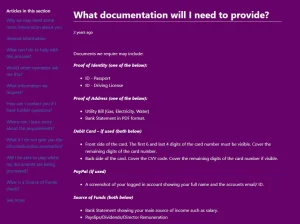
Royal Valley may request identity, proof-of-address, payment-method and source-of-funds evidence. These categories are not a statement that every player must submit every document on a fixed schedule. They are examples of evidence the operator says it can request when verification or financial checks are needed.
For source of funds, Royal Valley explains that some customers can be asked to show where gambling money comes from. Its examples include a bank statement showing the main source of income and supporting income evidence such as payslips, dividends or director remuneration. The dedicated verification page sets out the document examples, common rejection reasons and the operator’s published approval window in detail.
From an account-management perspective, the main lesson is to treat document requests as a separate workflow rather than as part of the initial sign-up form. If a request appears, follow the requested evidence list rather than sending unrelated files. Clear, current documents are less likely to create avoidable back-and-forth during review.
Financial vulnerability checks are a regulatory layer
UK Gambling Commission rules require relevant remote operators to conduct financial vulnerability checks when the applicable regulatory conditions are met. This is a separate concept from Royal Valley’s user-selected deposit-limit tool. A player chooses a deposit limit as an account control; a vulnerability check is an operator-side regulatory process.
The approved fact set for this page supports the existence of the regulatory requirement but does not need a detailed threshold table to answer the account intent. Thresholds and implementation rules can change, so this page avoids turning a regulatory mechanism into a fixed promise about exactly when any individual Royal Valley customer will be checked.
The useful distinction is procedural: account controls such as deposit limits and reality checks are settings visible to the player, while verification and vulnerability checks can be initiated as part of the operator’s compliance obligations. Both can affect how an account is used, but they have different purposes.
How to use the account controls before depositing
- Decide whether you want a daily, weekly or monthly deposit limit before funding the account.
- Set the limit at a level you are comfortable keeping, because an increase takes 24 hours to become active.
- If the limit feels too high, reduce it rather than waiting, as Royal Valley says a decrease applies immediately.
- Set a reality-check interval if you want regular prompts about session length.
- Keep identity and address records current so that a later verification request is easier to answer.
- If you want an extended break from Royal Valley, review the operator’s self-exclusion option; if you want a wider online exclusion, review GAMSTOP.
This sequence is not a registration shortcut. It is a way to approach the account as a controlled environment from the beginning, with spending, time and access decisions made before they become urgent.
Account controls and licensing are connected, but not identical
The account-level tools on this page operate within a regulated Great Britain gambling environment, but a licence page answers a different question: who holds the operating licence, what domain is linked to it and what regulatory history is documented. To keep those intents separate, see the Royal Valley licence.
That separation also helps avoid overclaiming. A licence does not mean an individual account will never be asked for documents, never encounter a control, or receive instant approval for every action. Regulation creates obligations and processes; it does not remove account-level checks.
Source notes
Royal Valley’s official help centre was rechecked on 28 September 2026 for deposit limits, self-exclusion, reality checks and verification-document categories. The Gambling Commission’s current LCCP pages were rechecked for remote self-exclusion and financial vulnerability requirements, and its current multi-operator self-exclusion code was used for the GAMSTOP participation requirement.
- Royal Valley: deposit limits
- Royal Valley: self-exclusion
- Royal Valley: reality checks
- UKGC: remote self-exclusion code
- UKGC: remote multi-operator self-exclusion code
- UKGC: financial vulnerability checks
For broader context, see the Royal Valley review.