Royal Valley Casino Verification and KYC
 Available in GB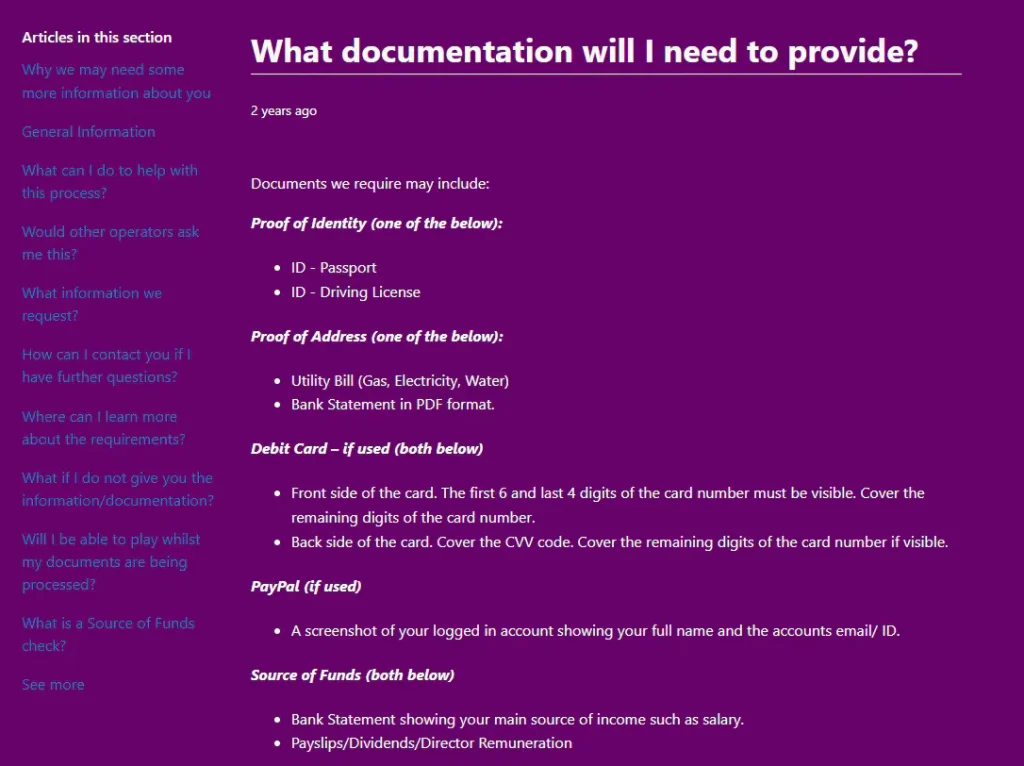
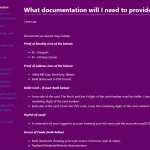
Royal Valley says verification requests can include proof of identity, proof of address, payment-method evidence and source-of-funds evidence. Its official help centre lists a passport or driving licence as identity examples, utility bills or PDF bank statements as common address evidence, and method-specific evidence for a debit card or PayPal account when those methods have been used. Source-of-funds requests can include a bank statement showing the main source of income plus supporting evidence such as payslips, dividends or director remuneration.
Not every player is told to submit every item on that list. The documents required depend on the request made for the account. Once documents have been uploaded, Royal Valley says to allow up to three full working days for approval, while noting that it is often sooner. That is an approval allowance, not a promise that every case will take three days or that every account will be asked for the same evidence.
Table of Contents
- Royal Valley KYC document checklist
- Identity evidence: keep it simple and readable
- Proof of address: accepted evidence and important exclusions
- Payment-method evidence: what the operator is trying to verify
- Source of funds: what the request is about
- Why documents get rejected
- How long verification can take
- KYC does not mean every withdrawal triggers the same check
- Financial vulnerability checks are related but distinct
- A cleaner upload process
- Verification and the licence context
- Source notes
Royal Valley KYC document checklist
| Evidence category | Official examples | Practical preparation |
|---|---|---|
| Proof of identity | Passport or driving licence | Use a clear image of the requested identity document and make sure the document is valid. |
| Proof of address | Utility bill or PDF bank statement | Use an address document that matches the account holder and meets the operator’s recency requirements. |
| Debit card evidence, if used | Front and back images with sensitive digits and CVV obscured as instructed | Leave the first 6 and last 4 card digits visible on the front and cover the CVV on the back. |
| PayPal evidence, if used | Logged-in account view showing full name and account email or ID | Capture the identity details requested without adding unrelated personal information. |
| Source of funds, when requested | Bank statement plus supporting income evidence such as payslips, dividends or director remuneration | Send the evidence specified in the request rather than assuming one document will satisfy every case. |
The list is best read as a menu of possible evidence, not as a mandatory bundle for every account. Royal Valley’s own wording says documents may include these categories. If the request email or account prompt asks for something specific, that request should take priority over a generic checklist.
Identity evidence: keep it simple and readable
Royal Valley’s core identity examples are a passport and a driving licence. The operator’s separate accepted-ID guidance says it needs the photo side of one of those documents for proof of identity. This page does not expand that into alternative forms of ID unless the operator explicitly lists them, because adding plausible but unsupported documents would make the checklist less reliable.
Readability matters. Royal Valley’s rejection guidance says low-quality, blurry or unreadable files can be rejected, and that it accepts formats such as a digital photo, scanned image and PDF but does not accept printouts. It also lists expired or too-old documents as a rejection reason. For a straightforward upload, the safer approach is to use the original document or a clear digital capture rather than a photocopy of a photocopy.
The operator also says documents should not be cropped and that all four corners should be visible where possible. The aim is to make the document easy to inspect without cutting off the details that establish its authenticity and ownership.
Proof of address: accepted evidence and important exclusions
The main Royal Valley documentation article gives a utility bill or PDF bank statement as proof-of-address examples. Its dedicated address guidance adds that a driving licence can be used for proof of address when it has not already been used as proof of identity, and that a utility bill or bank statement should show the player’s name and address and meet the stated recency rule.
The help centre also publishes examples of address evidence it does not accept for UK players. Those include payslips, National Insurance documents and banking letters of any type. That is a useful distinction because a document can contain an address and still fail the operator’s accepted-evidence rules.
Royal Valley’s broader address article lists other alternatives in specific circumstances, but a player should not build a submission from a long generic list if the operator has asked for a particular type. The most efficient route is to match the live request and make sure the name and address are clearly visible.
Payment-method evidence: what the operator is trying to verify
Where a debit card has been used, Royal Valley says it may ask for images of both sides. Its help article instructs players to leave the first six and last four digits visible on the front while covering the remaining card-number digits, and to cover the CVV on the back. That masking rule is important because verification should not require exposing the full card number or security code.
For PayPal, Royal Valley’s example is a logged-in account view that shows the customer’s full name and the account email or ID. The purpose is to connect the payment account with the player identity without asking for unrelated transaction history unless separately requested.
These are method-specific examples. They do not prove that every payment route will generate the same document request, and this page does not invent evidence rules for methods that are not covered by the approved fact set.
Source of funds: what the request is about
Royal Valley explains a source-of-funds check as a request made to some customers to show where gambling money comes from. Its help article gives examples such as salary, business profits or proceeds from a property sale when explaining the concept. The main documentation page then lists a bank statement showing the principal source of income together with supporting evidence such as payslips, dividends or director remuneration.
The practical point is that source of funds is not another name for ordinary proof of identity. Identity evidence establishes who the player is. Source-of-funds evidence is intended to support the origin of the money being used for gambling and to meet the operator’s regulatory obligations. A request can therefore ask for financial context even after identity has already been established.
Royal Valley also says it can request enhanced documentation in some circumstances and that customers should follow the specific documentation request they receive. This is why the page avoids saying that one bank statement automatically resolves every source-of-funds review.
Why documents get rejected
Royal Valley’s official rejection article gives several concrete reasons: a file can be low quality, blurry or unreadable; it can be a printout; it can be expired or too old; it can be incomplete or cropped; a card image can be missing a required signature; or the name can fail to match the account holder. These are process failures rather than evidence that a player has done something improper.
There are also category-specific exclusions. For UK proof of address, Royal Valley lists payslips, National Insurance documents and banking letters as examples it does not accept. A payslip can still appear in a source-of-funds request, which illustrates why document purpose matters: the same type of paper can be relevant for one check and unsuitable for another.
Before uploading, check three things: the document category matches the request, the document is current enough for that category, and the image or PDF shows the information the operator needs. That basic preparation addresses most of the rejection reasons Royal Valley itself publishes.
How long verification can take
Royal Valley says that after documents are uploaded, customers should allow up to three full working days for approval, although the operator notes that approval is often sooner. The safest planning assumption is the published outer allowance, not the quickest anecdotal case.
Working days are different from calendar days. A submission close to a weekend can therefore feel longer even without any problem in the review. The operator says it will notify the customer by email when the documents are approved.
This timing belongs to document approval. It should not be merged with withdrawal processing times. If verification is relevant to a cashout, the document-review stage and the withdrawal stage can both affect the overall calendar. For the separate cashout limits and timings, see the Royal Valley withdrawals.
KYC does not mean every withdrawal triggers the same check
A common mistake is to turn the existence of KYC into a rigid claim that every withdrawal requires a fresh upload of every document. The approved Royal Valley evidence does not support that statement. Its help centre describes categories of documents that may be requested and explains that additional or enhanced documentation can be requested when needed.
That matters for interpreting the payment journey. Verification can affect an account or withdrawal workflow, but the trigger, scope and exact evidence request can differ by account. The safer statement is that players should be ready to respond when the operator asks for evidence, not that a fixed KYC package is automatically attached to every cashout.
For the broader account controls that sit alongside verification, including deposit limits, reality checks, self-exclusion and GAMSTOP context, see the Royal Valley account.
Financial vulnerability checks are related but distinct
UK Gambling Commission rules require remote operators to carry out financial vulnerability checks when the relevant regulatory conditions are met. That regulatory process is connected to customer protection, but it should not be described as identical to a Royal Valley document request. One is a regulatory requirement that can be triggered under defined conditions; the other is the operator’s practical evidence-gathering workflow.
The approved research supports the existence of these checks, but this page does not publish a fixed threshold table or claim that reaching a particular number will always produce the same document request at Royal Valley. Regulatory thresholds and implementation details should be taken from the current Gambling Commission rules when needed.
A cleaner upload process
- Read the exact request before gathering documents.
- Use the requested category: identity, address, payment-method or source-of-funds evidence.
- Make sure the file is readable, complete and not cropped.
- Check that names and addresses match the account where the document is meant to prove those details.
- For debit-card images, follow Royal Valley’s masking instructions and never expose the CVV.
- Do not use a printout if the operator requires a digital photo, scanned image or PDF.
- After upload, plan around the published allowance of up to three full working days for approval.
The goal is not to send the largest possible bundle. It is to send the specific evidence requested in a form that is easy to review.
Verification and the licence context
Verification requirements sit within Royal Valley’s regulated operating environment, while the separate licence page covers the operator identity, licence record and regulatory history. For that evidence, use the Royal Valley licence.
Keeping those topics separate helps avoid two opposite mistakes: treating KYC as proof that every account has a problem, or treating a licence as a promise that no verification will ever be required. A regulated account can still involve document checks, and those checks should be described from the operator’s actual published process.
Source notes
Royal Valley’s verification help centre was rechecked on 28 September 2026. The current pages support the document categories, the three-working-day approval allowance, the common rejection reasons, the proof-of-address exclusions and the source-of-funds explanation used above.
- Royal Valley: documentation required
- Royal Valley: document approval time
- Royal Valley: document rejection reasons
- Royal Valley: proof-of-address exclusions
- Royal Valley: source-of-funds check
- UKGC: financial vulnerability checks
For broader context, see the Royal Valley review.
Royal Valley Casino Payment Methods
Royal Valley Casino Licence, Operator and Regulatory Record
Royal Valley Casino is linked in the UK Gambling Commission public register to Grace Media...
Royal Valley Casino Account, Registration and Player Controls
A Royal Valley account is more than a sign-up form. For a UK player, the...

Royal Valley Casino Bonus and Free Spins
Last checked: 28 September 2026. Royal Valley Casino's current UK welcome promotion is 25 free...

Royal Valley Casino Games and Software
For the wider operator, licence, payments and support picture, start with the Royal Valley review....
Royal Valley Casino Payment Methods
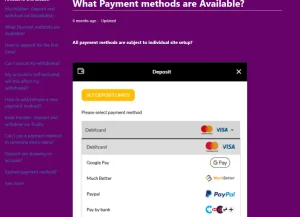
Verified Royal Valley payment options for UK players include Visa and Mastercard debit cards, PayPal,...
Royal Valley Casino Mobile and Android App
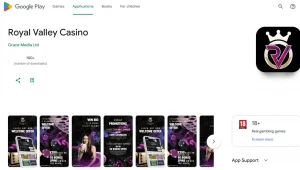
Royal Valley Casino has a verified Android app listing on Google Play under Grace Media...